
Miramar, FL · Garage Door Service
Garage Door Cable Repair for Miramar Homes
Snapped or frayed garage door cables are common in Miramar's 1960s-70s housing stock. We repair lift cables and drums across the service area, fast.
- Repairs & new doors
- Springs & openers
- Serving 4 nearby communities
What Causes It Around Here
Most of the houses in this part of South Florida went up between 1953 and 2005, with the bulk of the stock dating to the 1960s and 1970s. That matters for cables because the original drums, tracks, and galvanized lift cables on those builders-grade doors are now 50 to 60 years old in a lot of cases, and cable isn't a part that lasts forever even when it's never touched. Add the mild, humid year-round temperate climate common to this stretch of Florida and you get a slow, steady corrosion problem rather than the sudden freeze-thaw cracking you'd see up north. Salt-tinged humidity doesn't flash-rust a cable overnight, but it does work into the strands at the drum end and the bottom bracket, where moisture sits longest. We see the same failure pattern across the whole service area covered from this shop - homes built in that same mid-century wave have the same thin-gauge cable spooled on the same style of drum, and it wears out on the same rough schedule whether the torsion spring is original or already replaced. A door with a newer opener but original 1970s cable is one of the more common combinations we run into on a service call.
How It Shows Up
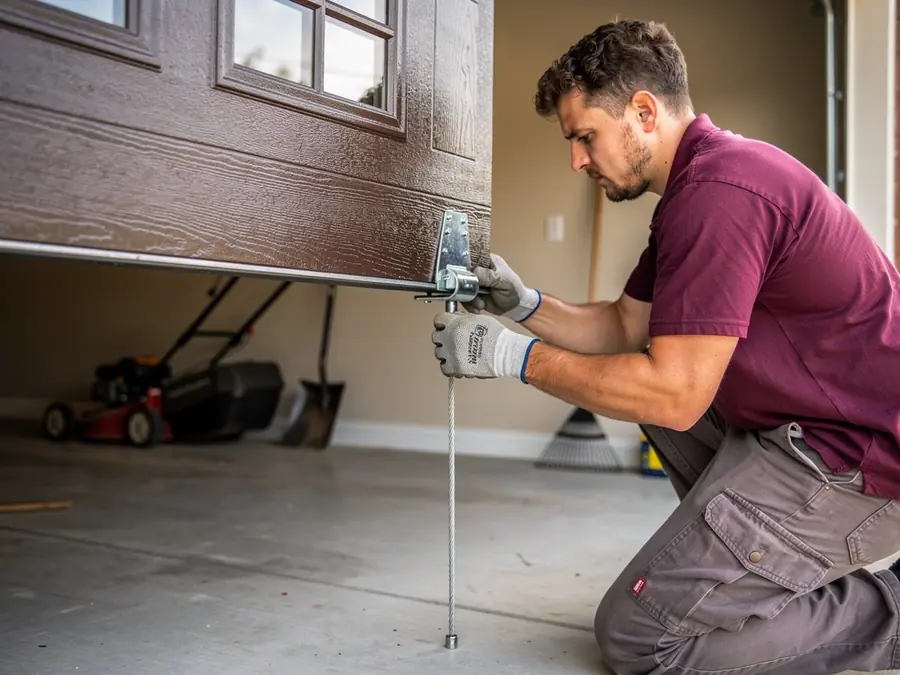
A fraying cable rarely fails without warning if you know what to look for. The first sign is usually a door that hangs crooked - one corner a few inches lower than the other - because one cable has started to slip off the drum or has a few strands already gone. You might hear a light ticking or popping sound as the door travels, which is loose strands slapping the track or the drum. Sometimes it shows up as a door that reverses itself partway through closing, because the opener's safety sensors read the uneven pull as an obstruction. The worst version is no warning at all: the cable lets go completely, the door drops hard on one side, and now you've got a door that won't move and a spring still under full tension. None of these are cosmetic. A door running on a compromised cable is a door that can come off its track or drop suddenly, and that's not a wait-and-see repair.
Where This Job Goes Sideways
Cable repair looks simple from the driveway - unspool the old one, wind on a new one - but the spring has to be unloaded and reloaded correctly to do that safely, and that's where people get hurt or make the door worse. We also run into doors where the cable broke because the drum itself is worn or mismatched to the door's weight, which means replacing the cable alone just sets up a repeat failure in a few months. On older doors from that 1960s-70s building wave, we sometimes find a replacement part that doesn't quite match the original drum pitch or track width, which throws the whole system out of balance even with a brand-new cable installed. Here's the honest limit: if the drums are rusted through or the tracks are bent from the drop, we're not going to sell you a cable-only fix that won't hold - at that point replacing the hardware set costs less over time than repeating the same service call.
Can You Do This Yourself
We're not going to pretend this is a job for a Saturday with a socket wrench. The spring on a residential garage door - torsion or extension - stores enough energy to cause a serious injury if it releases while you're working near it, and cable replacement means working right next to a loaded spring. If the cable has simply slipped off the drum and the door is otherwise undamaged, sometimes a careful re-seating is possible without full disassembly, but there's no safe way to tell that from a visual check alone. What you can do yourself: don't force the opener, don't pull the emergency release while the cable is frayed, and don't let anyone park under or walk through the door until it's looked at. That's the limit of the DIY part of this job.
Frequently asked questions
Why do garage door cables fail more in older Miramar neighborhoods?
A lot of the housing stock here dates to the 1960s and 1970s, which means original or early-replacement cables and drums are decades old. Combined with the mild, consistently humid South Florida climate, cables corrode slowly from the inside out at the drum and bottom bracket rather than failing from cold-weather stress.
Can I replace a garage door cable myself?
Not safely in most cases. The spring holding the door up stores enough force to cause serious injury, and cable work happens right next to it. If a cable has only slipped off the drum with no fraying, a careful re-seat may be possible, but that's not something you can diagnose from a visual check.
Is a snapped cable always an emergency?
Treat it as one. A door with a broken cable can drop suddenly or hang crooked under spring tension that's no longer balanced correctly. Don't use the opener and keep people and vehicles clear of the door until the cable is replaced.
Will replacing the cable fix a crooked door for good?
Only if the drum and track are still in good shape. On older doors we sometimes find a worn or mismatched drum that caused the cable to fail in the first place - in that case, replacing just the cable is a short-term fix, and we'll tell you that up front.
Related services
Related guides
By Neighborhood
Cable Repair across the Miramar area
We also handle cable repair in these Miramar-area suburbs.
Book garage door service in Miramar
Call now or request a quote - tell us what the door is doing and where you are.