Miramar, FL · Garage Door Service
Garage Door Panel Replacement in Miramar
Dented, rusted, or bowed garage door panels are common on Miramar's 1960s-70s housing stock. Here's why it happens, how to spot it early, and when a panel swap beats a full door.
- Repairs & new doors
- Springs & openers
- Serving 4 nearby communities
What Causes It Around Here
Most of the houses in this part of the housing stock went up between 1953 and 2005, with the typical home dating to 1972. That matters for panels specifically: a door installed when the house was built, or replaced once in the 80s or 90s, is running steel or aluminum gauges that were standard back then - thinner than what goes on a new door today. Across the 45 named neighborhoods that make up this stretch of the service area, the bulk of the stock is 1960s and 70s construction, so a huge number of garages are carrying the same era of door.
The mild temperate climate here isn't the kind that cracks panels with freeze-thaw cycling the way a northern winter does. What it does instead is bake thin steel through long stretches of heat, which softens seams and accelerates rust at the bottom panel where moisture collects after rain and doesn't fully dry before the next humid stretch. A panel that looks fine in January can be visibly bowed by August. Add a stray basketball, a trailer hitch backing in wrong, or a kid's bike against the door, and a dent on an already-softened panel turns into a buckled section fast. That combination - old gauge steel plus sustained heat and humidity - is why panel failure shows up here more than the dent alone would explain.
How It Shows Up
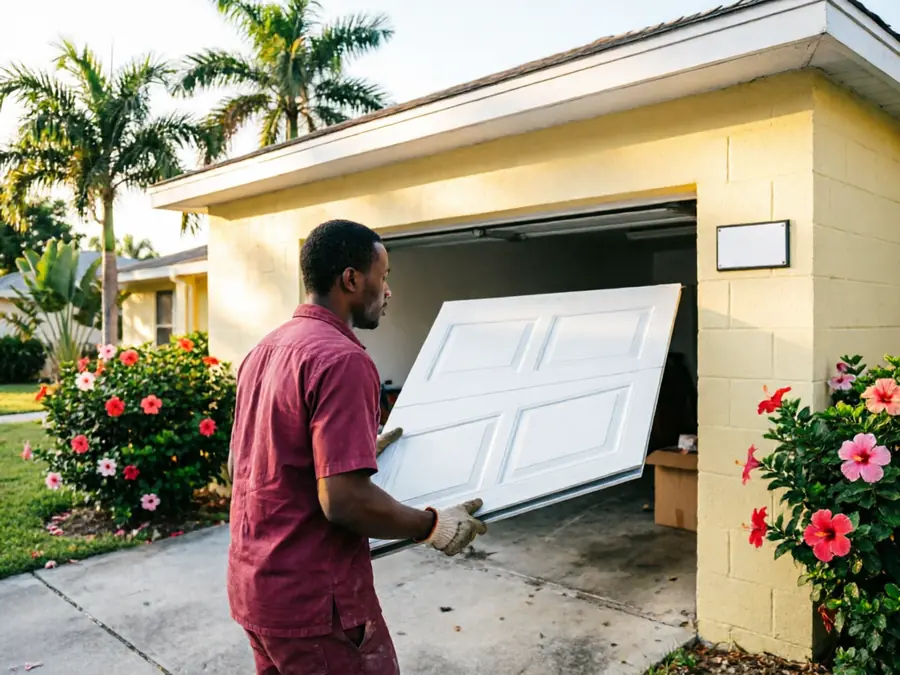
The most obvious sign is a visible dent or crease, usually at waist height where something hit the door directly. But panel trouble doesn't always start with an impact. Watch for a bottom panel that looks slightly swollen or rippled compared to the ones above it - that's rust working from the inside of a hollow steel panel, and by the time you see it on the surface it's already eaten through some of the material. A panel that's pulling away from its neighbor, leaving a visible gap or a line of daylight along the seam, means the hinge or the panel itself has started to fail structurally, not just cosmetically.
You might also notice the door running rougher through one section of travel, or catching slightly as it passes a bowed panel in the track. Sometimes it's just paint - a panel with sun-faded color that doesn't match the rest of the door anymore because it took more direct heat over the years. That one's cosmetic, but it's worth noting separately from structural dents, because the fix and the cost are different. If your door seals unevenly at the bottom, letting in a visible line of light or water, that's usually the bottom panel, and it's worth addressing before the next heavy rain finds its way in.
Where This Job Goes Sideways
Matching a single panel to a door that's thirty or forty years old is the part that trips people up. A lot of the doors on 1960s and 70s stock were made by manufacturers that have since changed their panel profiles, widths, or color lines, so the exact match isn't always available. Sometimes the fix is a close match that's visibly a slightly different shade or rib pattern, and the homeowner has to decide if that's acceptable or if it's time to replace the whole door instead.
Here's the honest limitation: if the door is more than a couple of decades old and one panel is already failing, odds are the other panels aren't far behind, and the hardware - hinges, rollers, the track alignment - has worn in a way that doesn't always play nice with a brand-new panel bolted next to old ones. We'll tell you straight if a single-panel swap is a short-term patch rather than a real fix. With 130,249 owner-occupied houses across the service area running a mix of original and once-replaced doors, we see this exact call - patch one panel or replace the door - often enough that it's rarely a quick yes or no.
Alignment is the other failure point. Swap a panel on an old torsion system without checking spring tension and track plumb, and the door will bind or reverse unexpectedly on the opener.
Can You Do This Yourself
A panel swap is mechanically simple in theory - unbolt the damaged section, bolt in the new one - but it's rarely that clean on a door that's been in place since the house was built. The hardware has settled, the track may have shifted slightly over the decades, and torsion springs under tension aren't something to work around without the right bars and a clear idea of what you're doing. If you get the spring side wrong, the door can slam down hard enough to hurt someone or crack the panel you just installed.
At a median household income of $66,858, most owners here want the cheaper single-panel fix to work rather than jumping straight to a full door. That's a reasonable instinct, and it often works - but it only works if the replacement panel actually fits the existing track width and hinge spacing, which takes measuring the door correctly before you order anything. If you're comfortable with hand tools and the door is a newer sectional model with standard panel sizes, a cosmetic swap on a non-torsion panel is within reach for a careful DIYer. Anything involving the spring-loaded sections, a bowed structural panel, or a door old enough that the manufacturer's specs aren't printed anywhere is where it's worth having someone look at it in person first.
Frequently asked questions
Can you replace just one panel instead of the whole garage door?
Often, yes - if the rest of the door is sound and a matching panel is still available for that model. The catch is that doors from the 1960s-70s building boom here sometimes used profiles that aren't made anymore, so the panel you get may be a close match rather than identical. We'll look at your door and tell you straight whether a single panel makes sense.
Why does my bottom panel rust out before the others?
It sits closest to the ground, collects standing moisture after rain, and in this mild but humid climate it doesn't always dry fully before the next wet stretch. Hollow steel panels rust from the inside first, so by the time you see rippling or discoloration on the surface, the metal underneath has already thinned.
Is it worth fixing an old door versus replacing it?
Depends on the age and how many panels are affected. If one panel failed on a door that's otherwise tight and the hardware is in good shape, a swap is worth it. If the door is old enough that panels, hinges, and rollers are all showing wear together, putting money into one panel is often just delaying a full replacement.
How long does a panel replacement take?
We don't have a fixed number to quote you without seeing the door and confirming the panel is in stock - availability varies a lot depending on the door's age and manufacturer. What we can tell you is that alignment and spring checks add time beyond just swapping the panel itself.
Related services
By Neighborhood
Panel Replacement across the Miramar area
We also handle panel replacement in these Miramar-area suburbs.
Book garage door service in Miramar
Call now or request a quote - tell us what the door is doing and where you are.